
One question I’m constantly asked is if I’ve found “the one”. We often struggle to find the one Bible that replaces all other Bibles for reading, carrying, and studying. Many search for their one Bible, only to be dissatisfied with one feature, and then move to the next Bible. It’s a never-ending cycle of buying, and it often gets in the way of actually using the Bible. This is a first-world problem (many countries don’t even have Bibles), but the struggle is real, and you’re not alone.
(To answer the question – no, I haven’t found the one. I’ve linked to my current Bibles at the end of this article.)
Why We Can’t Find The One

CSB Giant Print
We usually want one Bible that ticks all the boxes. The problem is that there are a lot of boxes that cancel out other boxes. We want a thin Bible with thick paper, or a small Bible with giant print. This requires compromises that we’re not always willing to make.
There are many types of Bibles to choose from, including study, reference, text-only, reading, wide margin, and journaling Bibles. They’re available in many design variations with different paper, fonts, bindings, sizes, and layouts. There are a lot of theological preferences for translations, commentary notes, and denominational leanings. Each serves a different purpose.
There are many reasons we keep searching. We tend to think, “If I had this or that Bible, I’d read more”. Then, we get that Bible, find that it doesn’t tick one of our boxes, and look for the next one. We can spend more time looking for Bibles than reading them (which is something I know all too well. I even launched this website to help me choose one).
We’re faced with decisions about translations (accuracy vs readability), features (notes vs clean text), portability (small print vs large print), durability (build quality and materials), and cost. We also want it to feel right. This is something we can’t always explain, but we know when a Bible feels like it’s ours. I’ve even described a Bible (a Cambridge Concord) as MY Bible when I own multiple Bibles.
FOMO (the fear of missing out) is a trap. It can push us into a never-ending spiral of having to get the next thing. This is fueled by social media and product reviews (including those here at Bible Buying Guide, which was never meant to fuel consumerism). Comparison can be helpful, but it can also distract us from making a decision, or worse, from reading and studying God’s Word.
The problem is made worse if we ask for advice. Ask 10 people and you’ll get 10 different answers on which Bible is best. We also feel the need to defend our choices. We shouldn’t have to defend if we like single vs double columns, with or without references, thin vs thick paper, etc. It’s okay to like what we like. It’s okay to not like what someone else likes. We’re all different, have different needs, and are in a different place in our walk with God.
There is No Perfect Bible For Every Use
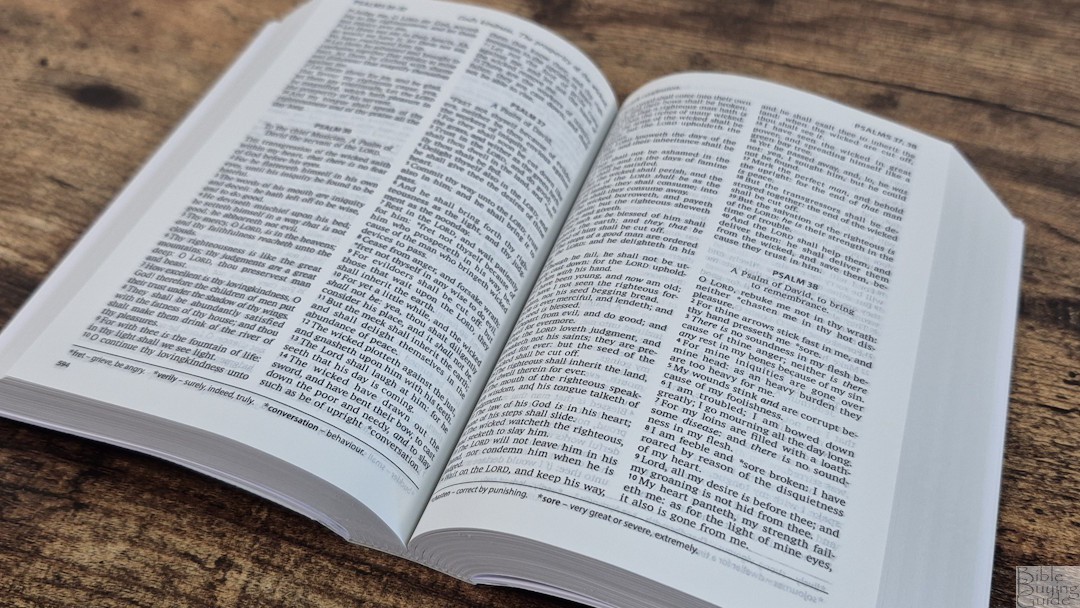
Hampton KJV
Bibles are made for specific purposes. No one Bible fits perfectly for every need, but there can be a perfect Bible for your current season. I think a better approach is to have one in each of our categories. Rather than finding one Bible that does everything, find a few Bibles that do one thing well. This advice stems from my experience as both a technician and a guitar player, and numerous real-world examples support this train of thought.
Guitarists often have multiple guitars for different styles, tunings, and tones. It’s possible to get a lot of sounds from a single guitar, but it’s much easier, and sometimes the only option, to just pick up another guitar. As a technician, I carried a multitool, but I’d grab a real screwdriver every time. The multitool was handy, but it was cumbersome. It had a lot of things, including a saw, file, screwdriver, and pliers, but none of them were good enough to replace the real tools.
A reference or Study Bible is a multitool. It does a lot of things, but it doesn’t do all of them well. Their tools can get in the way of reading, and you’d need external tools for sermon prep or deep study. They’re good for basic Bible study. They could be good enough for your most common uses, but sometimes you just want to read. Sometimes you need to find a word that’s not in your concordance. Sometimes you want to make notes, but that’s difficult without enough margin space. Text-only Bibles focus on the text. They’re great for reading, but you’d need external tools for all of your studies.
My Recommendations
Define the purpose of the Bible and purchase according to that purpose. Do you need it for reading, preaching, carrying, journaling, witnessing, or studying? Narrow it down as much as possible.
Try it first. We have fewer physical stores now, but some Bibles can still be found at Barnes & Noble, Books-a-Million, and other bookshops. Read or watch reviews that include flip-throughs. Look at samples on Christianbook, Amazon, or the publisher’s websites.
Make a list of the Bibles that best fit your needs and focus on those. It’s better to have a Bible for each purpose, so you’ll have one that excels at one thing and use it for that one purpose, and choose the Bible from your shelf that fits your current need.
Keep in mind that your habits and daily needs change as you grow. If you find that you pick up one Bible most of the time, just use that one until your needs change.
Ending Thoughts
There are worse things we can put our money into than buying multiple Bibles, but the point of having a Bible is to read and study it. It’s better to have fewer Bibles that get used than to search for the next Bible because one doesn’t fit every purpose. It’s okay to hunt for Bibles, but don’t let the hunt for the perfect Bible get in the way of the joy of the Scriptures themselves.
For those who will ask about me, I’m currently using (affiliates):
- TCR (Thompson Chain Reference) and Logos for most studies
- Concord for carrying
- Kindle Oasis with the translation I’m reading this year for my yearly reading-through
- Thomas Nelson Premier Collection Giant Print KJV for preaching
What about you? What are you currently using? Let us know in the comments.







Great read as always Randy.
I agree. Different bibles for different purposes. I do not try to find “the One” (although I used to!)
Currently using:
NLT Personal Edition ‘96 text (late 90’s edition)
NKJV Broadman LPUT (Korea Print)
ESV Cambridge Clarion
(All have been rebound by 1:9 Bibles)
Nice read. Thanks for writing this. I’ve experienced every part of that article. What pangs me is my preferred translations (LSB & NASB95) do not have a large print thinline reference in paragraph format. Maybe you could put in a good word to the publishers for the need to print one- LOL! My current rotation of Bibles:
1. LSB Two column v-b-v. It’s a clean thinline portable Bible with a nice large enough font. The only drawbacks are that it lacks references and is not in paragraph format.
2. LSB PPR. It’s good for on the go when you need a compact, but not idea to read for long periods of time.
3. NASB Clarion & NASB Large-print Compact Bible. I use it the same as the PPR.
4. ESV Heritage Bible. A nice clean reading Bible. I would like the same in a two-column layout across different translations.
NASB95 Schuyler Quentel. Best format would like it to be 10.5 font and more thinner; but it is the closest to checking most of my boxes.
For study:
LSB MacArthur Study Bible. It has great resource for study, but the 9.5 comfort print feels a bit too probably because the space between the lines are tight to make room for thousands of notes. Does make for reading for long periods of time.
ESV Study Bible. Excellent resources, wish that it was available in other translations.
KJV RHB Study Bible. Same as the ESV Study Bible.
Honorable mention:
NASB Grace and Truth Study Bible
NASB Thompson Chain Reference Bible
NKJV Large Print Thinline Bible
My One for over a year has been the NIV Thinline Center Column Reference, the center margin gave me extra white space for note taking & the outer/inner margins have more space than a typical thinline for notes as well. The cross references & footnotes are very good for further study. All in a compact hand size format!
Now am still using it alongside the NLT Thinline Reference, though doesn’t have as much space for notes but is an excellent translation for clarifying some difficult passages.
And for more devotional style reading, I’m using the Personal Promise Bible New Testament with Psalms & Proverbs that I bought about 20 yrs ago, where your name gets placed within scripture (& spouse as applicable) to “personalize” it. It’s a bit of a game changer to read!
I’m guilty of this, and not just with Bibles but with most things I care about. I reckon it’s a certain personality type thing. On the bright side, I learn so much about Bible construction and design during the process. As with most things I really get into, I find myself decision fatigued after a while and just settle with one Bible that does most things well. I do get FOMO if the next thing pops up in my feed, but my extensive research does help give me that reality check why I don’t need it.
I just saw this article and perhaps I began reading articles by Mark Bertram 20 years ago. And quite honestly I was never able to read or find the perfect bible reading experience. Then comes Randy Brown. What’s the difference is that my first bible I bought recommended by Randy was the Trinitarian Westminster Reference Bible. The price matched a gift card I used for an online purchase. What I gained was the best Bible reading experience I had read in the Authorized version. Mr. Bertram presented the case that the reader deserved better and Randy has served as a conduit for pointing a way to find that elusive best Bible .
Is there a note taking KJV , red letter, 10.5 fonts are larger, cross references, with concordance? (2.5”-3” not taking)? If someone had this, it would be GREAT!
I mean 2.5”-3” note taking space,
thank you
I have several premium Bibles, all KJV (it’s a lot easier reading experience when it’s the same text in different formats). I think I have something that can be said to be closest to “The One.” In this case, it’s the Schuyler Personal Size Canterbury. It just checks all the boxes.
The PSC is an excellent choice. If it were the only Bible I owned, I’d be happy with it.